TriviaHops
12 Things You Never Knew About Classic Video Games
Long before phones could hold a thousand games, arcades and living-room consoles were busy inventing the ideas we still play with today. Here are twelve true stories from the early days of video games: a few happy accidents, a couple of secrets, and one very tough little handheld.
1Pac-Man started life as Puck-Man

When Namco released its maze game in Japan in 1980, it was called Puck-Man. The name came from "paku paku," a Japanese phrase for the sound of a mouth opening and closing as it eats. For the release in North America later that year the name became Pac-Man, and that is the name that stuck around the world.
The game was designed by Toru Iwatani, who wanted an arcade game that would appeal to more than just fans of shooting games. Iwatani has said that a pizza with one slice missing helped inspire the hero's simple round shape.
The four ghosts are cleverer than they look. Blinky, Pinky, Inky and Clyde each follow their own rules for the chase. Blinky heads straight for you, Pinky aims for a spot just ahead of you, Inky's moves depend on where Blinky is, and Clyde backs off toward his corner whenever he gets close. That mix of personalities is why the ghosts feel like a team instead of four copies of the same enemy.
2Mario's first name was Jumpman
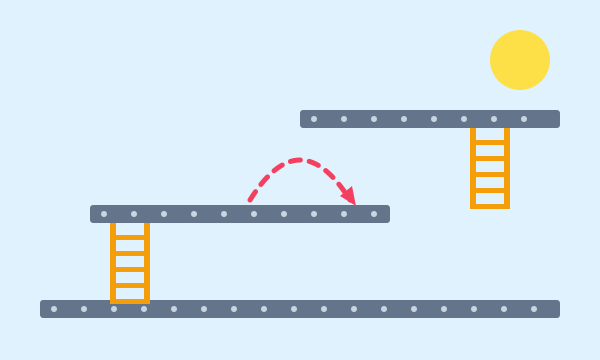
The hero of Nintendo's arcade game Donkey Kong (1981) was a small man in overalls who had to climb ladders and leap over rolling barrels to reach the top of a construction site. In Donkey Kong he was simply called Jumpman, a name that described exactly what he did. He was soon renamed Mario, and in Mario Bros. (1983) he switched jobs from carpenter to plumber.
His famous look came from the limits of the hardware. Designer Shigeru Miyamoto has explained that, with so few pixels to work with, a cap meant there was no hair to draw or animate, a mustache made the face easy to read without a detailed mouth, and overalls in a different color from his shirt made his arms easy to see when he moved.
Donkey Kong also told its little story with short scenes between stages, and jumping, now one of the most basic moves in gaming, was the heart of the whole game. Not bad for a character who started out without a real name.
3Tetris was born in Moscow in 1984

Tetris was created in 1984 by Alexey Pajitnov, a researcher at a computer center of the Soviet Academy of Sciences in Moscow. He wrote the first version on an Elektronika 60, a computer that could only show text, so the falling pieces were drawn with text characters.
The name joins two words: "tetra," the Greek prefix for four, because every piece is made of four squares, and tennis, Pajitnov's favorite sport. The game has seven different pieces, one for every way of joining four squares edge to edge (counting mirror images as different shapes).
Colleagues copied it onto other computers, and it spread quickly. A version for the IBM PC followed, and in 1989 Tetris came packed in with Nintendo's new Game Boy in North America, which put it in millions of pockets. For years Pajitnov earned almost nothing from his game, because the rights belonged to the Soviet state. That changed in 1996, when he and game publisher Henk Rogers founded The Tetris Company.
4The Konami Code began as a testing shortcut
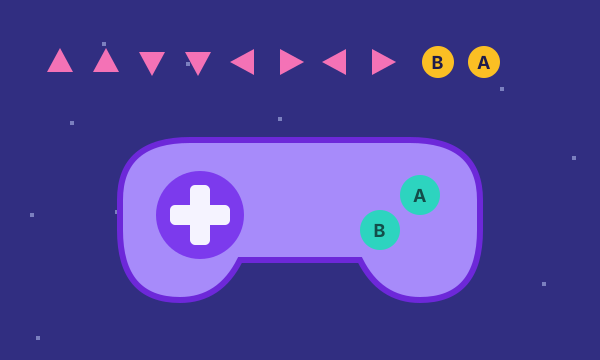
Up, Up, Down, Down, Left, Right, Left, Right, B, A. Plenty of players know this sequence by heart. It first appeared in Konami's home version of Gradius (1986) for the Famicom, Nintendo's console in Japan. Kazuhisa Hashimoto, who was converting the arcade shooter for the home system, found it too hard to play all the way through while testing it. So he added a secret button sequence that gave his ship a stack of power-ups.
The code stayed in the finished game, players discovered it, and Konami kept hiding it in later games. It became famous in North America with Contra (1988), where entering it on the title screen gave you 30 lives instead of 3. That made a famously tough game much easier to finish.
Since then it has turned up far beyond Konami's own games. Plenty of websites and apps hide a small surprise for anyone who types it in, which makes it one of the longest-running inside jokes in technology.
5Sonic was created to be Sega's mascot

At the start of the 1990s, Sega wanted a hero who could stand next to Nintendo's Mario and give its Genesis console (called the Mega Drive outside North America) a face. Teams inside the company pitched ideas, and the winner was a blue hedgehog drawn by artist Naoto Ohshima. Programmer Yuji Naka led the programming of the speedy game built around him.
Sonic the Hedgehog came out in 1991. Where most platform games asked you to move carefully, this one was about speed: loops, springs and long slopes sent Sonic racing across the screen and showed off what Sega's console could do. His blue matches the blue of Sega's logo, and he curls into a spiky ball to attack, much like a real hedgehog curls up to protect itself.
The plan worked. Later in 1991 Sega began packing Sonic the Hedgehog in the box with the Genesis in North America, and the hedgehog became one of the best-known characters in games, with cartoons, comics and, years later, movies of his own.
6A Game Boy that survived a fire still worked

Nintendo's original Game Boy, released in 1989, had a reputation for being tough. One unit proved it in an extreme way. During the Gulf War in 1991, a Game Boy belonging to an American soldier was badly burned during a bombing. Its plastic case was scorched and partly melted.
It still worked. With batteries in, the burned Game Boy switched on and played Tetris. Nintendo put it on display at its store in New York City, and for years visitors could watch the battered handheld running Tetris behind glass, melted case and all.
The Game Boy's simple design helped it earn that reputation. It used a low-power screen without a backlight and ran on four AA batteries, which could keep it going for many hours. Some color handhelds of the time ran through their batteries much faster. That long battery life, along with Tetris in the box, is a big part of why the Game Boy became one of the best-selling game systems ever made.
7Pac-Man has a final level, and it's broken

Pac-Man doesn't really have an ending, except for one. On level 256, the right half of the maze turns into a jumble of letters, numbers and colored blocks. There aren't enough dots left that can be reached to clear the board, so the level can't be finished. Players call it the "kill screen."
The cause is a counting limit. The game keeps the level number in a single byte, which can only hold values from 0 to 255. When level 256 comes around, the routine that draws the row of bonus fruit at the bottom of the screen gets the count wrong and keeps drawing, spilling garbage over half of the maze.
Getting there takes hours of nearly flawless play, so very few people have ever seen it in person. A perfect game means eating every dot, every power pellet, every piece of fruit and every blue ghost on all 255 playable levels. It scores 3,333,360 points, the highest score the game allows.
8Atari buried E.T. cartridges in the desert

In 1982 Atari released a game for its Atari 2600 console based on the hit film E.T. the Extra-Terrestrial. To have it in stores for the holidays, programmer Howard Scott Warshaw had about five weeks to make it, a very short time even back then. Atari produced far more cartridges than it managed to sell.
In September 1983, trucks carried loads of unsold Atari games and equipment to a landfill in Alamogordo, New Mexico, where they were buried. Over the years the story turned into a kind of legend, and plenty of people doubted it had happened at all.
In April 2014 a documentary crew, working with the city, dug into the landfill to find out. They found Atari cartridges, including copies of E.T., along with other games and hardware. Warshaw was there to watch. Some of the recovered cartridges were later sold to collectors and some went to museums, so a game that was once thrown away became a small piece of history.
9Space Invaders' speed-up was an accident

In Taito's Space Invaders (1978), rows of aliens march across the screen and step down toward your cannon. The fewer aliens are left, the faster they move, until the last one zips back and forth at top speed. That rising tension became one of the most copied ideas in games, and it wasn't planned.
Designer Tomohiro Nishikado built the game on hardware that struggled to move many shapes at once. With a full wave on screen, the machine could only update the aliens slowly. As the player shot them down there was less to draw, so the remaining aliens were updated more often and moved faster. Nishikado liked the effect and kept it.
The game's simple four-note bass loop speeds up along with the march, like a heartbeat getting faster. Space Invaders became a huge hit in Japan and then around the world, and because it showed the best score on screen, it gave players a reason to come back and try to beat it.
10Link's name has a meaning

The hero of The Legend of Zelda (1986 in Japan, 1987 in North America) is called Link, and the name was chosen on purpose. Nintendo's developers have explained that he is meant to be the link between the player and the game world: you are supposed to step into the adventure through him. In the first game you even type in a name of your own for him when you start.
The game felt different from most console games of its day. Instead of running through levels in a fixed order, you started out in the open with very few directions and were free to explore caves, forests and dungeons, often in more than one order.
In North America the game came on a gold-colored cartridge that stood out on store shelves. It also had a small battery inside, so it could save your progress instead of making you start over or copy down a password. And a mix-up that still catches people out: Zelda is the princess, and Link is the hero.
11Pong had one instruction
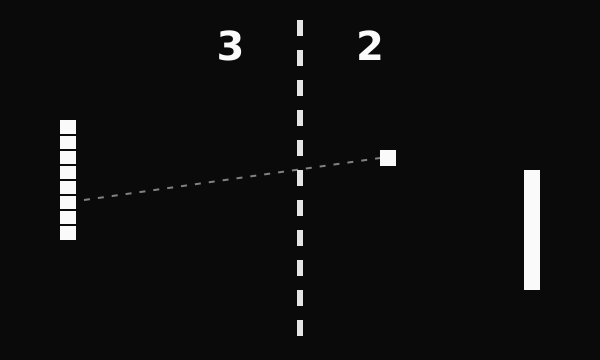
Atari's first arcade game, Pong, arrived in 1972. It was built by engineer Allan Alcorn after Atari co-founder Nolan Bushnell gave him the job as a practice project. The result was so much fun that Atari decided to sell it.
The cabinet's instructions were famously short: "Avoid missing ball for high score." That was all anyone needed. Each player turned a knob to move a paddle up and down, and a square ball bounced between them.
There was more going on than it looked. Each paddle was split into eight segments, and the angle of the bounce depended on which segment the ball hit, so catching it with the edge sent it off at a sharper angle than hitting it with the middle. The ball also sped up during long rallies, which kept games from going on forever.
The first Pong machine was set up in Andy Capp's Tavern in Sunnyvale, California, to see whether people would play it. They did, and Pong's success helped launch the arcade game business.
12A secret room in Adventure
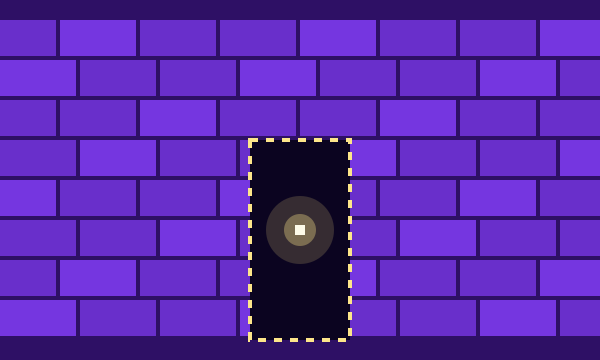
In the late 1970s Atari didn't put programmers' names on its games. Warren Robinett, who made Adventure (1980) for the Atari 2600, quietly found a way around that. He hid a secret room in the game with the words "Created by Warren Robinett" flashing on the wall.
Getting there was not easy. Players had to find a single gray dot, an object one pixel in size hidden in one of the game's mazes, carry it to the right place, and then walk through a wall that normally can't be passed. Robinett didn't tell anyone at Atari before the game shipped.
A young player found the room and wrote to Atari about it. Instead of removing the message, Atari liked the idea of hidden surprises for players to discover, and people at the company started calling them Easter eggs, after the egg hunts kids love. Hidden messages, rooms and jokes have been a gaming tradition ever since, and players still go looking for them.
That’s all 12. Thanks for reading!
12 Things You Never Knew About Classic Video Games · TriviaHops